
OKOT PA’ BITEK RETURNS TO THEATRE.
In a musical theatrical production called Echoes of Lawino.
Okot Pa’ Bitek is name that rings a bell, not just in Uganda, East Africa or Africa but also on the literary globe. His contribution to the African literature is unquestionably one of the most awe-inspiring especially in oral story-telling and traditional poetry forms. https://www.google.com/url?sa=t&source=web&rct=j&url=https://www.britannica.com/biography/Okot-pBitek&ved=2ahUKEwi3zreK7Jf_AhUQhf0HHRo2BpUQFnoECFUQAQ&usg=AOvVaw3TXMiRm17gQCkW6uMpCS-T
Born in June 7th 1931 and departed to the Land of Our ancestors in July 20th 1982, He is one of the popular celebrated African Creative writers, and the stands the test of time for his epic poem the song of Lawino; hailed as a masterpiece of World literature
To the students of Literature, He is one of the Poets whose Poetic sketches are studied as text, Students walk about with their heads held like peacocks about the Poetic verses from his collection, reciting a line or two and envisioning their lives in future as Poets inspired by him.
When you enter the Uganda National Theatre, on the second floor, the Green Room, Okot Pa’ Bitek’s portrait among the many is hanging on the wall. It is undoubted that the painter had a smile in his face while making the painting. It is a Painting of An African griot, An African Story-teller, one who could/would invite his children and grandchildren on an evening/night by the fire place and tell stories. Under a mango tree that formed an umbrella thick of hair.
From the 09th to 11th June 2023, Okot Pa’ Bitek returns to National theatre in a Musical theatrical production called Echoes of Lawino. One wonders why it is called Echoes of Lawino. We believe Okot Pa’ Bitek’s song is already in existence. This song still rings a bell in millions and thousands of ears. This song is whispered by birds, it is told by trees from branch to another, from one leaf to another, it is a song carried by springs, and some wear the song as a ring. The return of the Pa’ Bitek is an echo back into our ears. It is back to remind us of story of The People on the continent of Africa, of our culture that we are responsible for, it is a question of bridges of hybridity, or ridges of homogeneity. It is an observance of political power and will of sexes and gender roles in a fast growing generation, technological advancement meeting cultural norms that demand a pace to transform.
The Play Echoes of Lawino is an adaption from Song of Lawino written by Kitaka Alex and Ojok Okello. This is a production by Okere City. It is directed by Kitaka Alex. A Practicing Theatre Director, Writer, Poet and an Actor. It is a three-man act with a cast including Sharon Achiro acting as Lawino. Gladys Chaiga Destiny acting as Clementine and Ojok Okello acting as Ocol
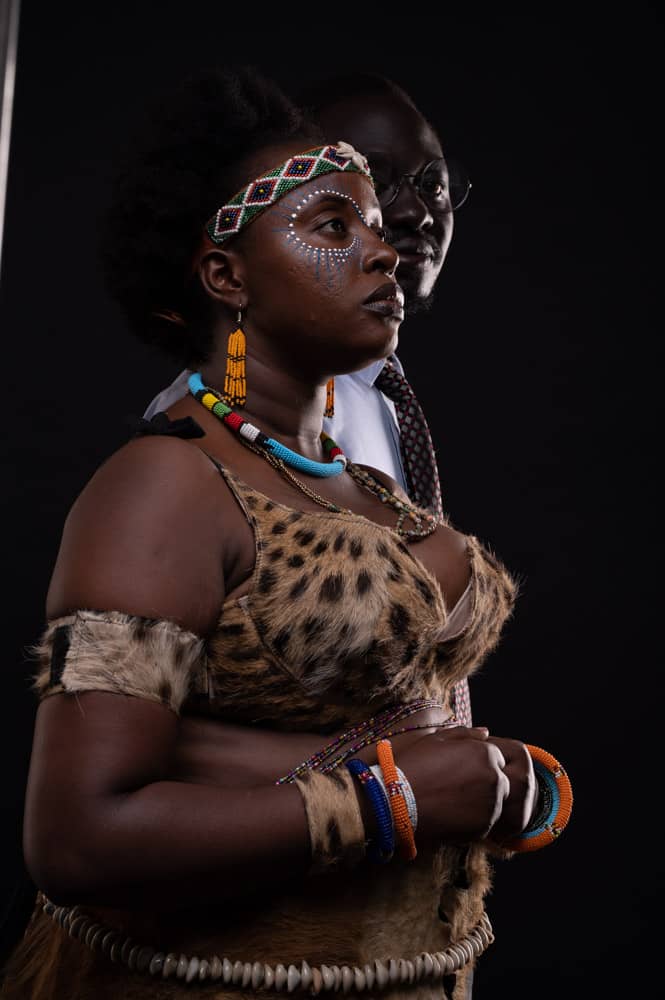

ECHOES OF LAWINO
An adaption.
By
Kitaka Alex (Playwright) & Ojok Okello (Executive Producer)
Adapted from the Poetry Collection of Song of Lawino and Song of Ocol by Okot P’Bitek
About the book. First published in 1966, “Song of Lawino” is the African woman’s lamentations over the cultural death of her western education husband. In “Song of Ocol”, the husband tries, in vain, to justify his cultural apostasy.
About the play: over half a century since the publication of “Song of Lawino” and “Song of Ocol” Africa has gone through fundamental political, economic, and social shifts. But many questions about African identity, history, heritage, and values remain complex themes. To date, Africa finds itself grappling with how to forge a sustainable path to the future that recognizes and appreciates its complex histories and foundations. Creating her future, grounded in strong cultures and complex histories is an uphill task she must climb. The play highlights the complex social and political contours Africans grapple with presented through the lenses of feminism, post-colonialism, and pan-Africanism. The play is brought to life by Okere City, a project reimagining traditional spaces and futures in a deep and remote northern Ugandan village in Otuke District. The play also sets out to address the cultural loss that we (Africans) face due to generations of social, religious, and political indoctrination. How can we be authentic: that is to ask; how can we reconnect with values that have stagnated into ceremony or symbol or; how can we discard some aspects of western modernity and start the process of being rooted in our authentic value systems? With this play, we intend to join the chorus of voices daring to reimagine a more decolonized African people.
Characters.
Ocol: Western-educated African man played by Ojok Okello
Lawino: Uneducated village woman played by Sharon Atuhaire Achire
Clementine: Ocol’s educated and feminist partner played by Destiny Gladys Chaiga
Time frame
1960’a at the bridge when Uganda was desiring its independence from the British. A bridge between Ugandans who had acquired education and those who were caught up in the transition.
 I am A 🌈 Divine Energy. I Rain